

Welcome to the first edition of Would You Automate This? In each issue, we'll present a real manufacturing challenge and walk through the questions automation engineers ask before deciding whether a robot is the right solution.
The Scenario
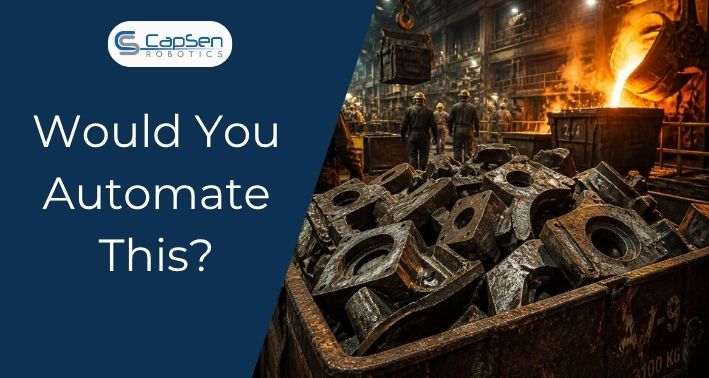
Imagine you're walking through a foundry. Freshly cast metal parts arrive in large bins. No two parts are sitting exactly the same way. Some are stacked, some overlap, and the parts are irregularly shaped. The task at hand is to pick one part at a time and load it into the next process in the line- accurately and safely.
It seems simple at first glance, unless you ask a robot to do it.
Before answering, consider these questions:
1. Can the robot identify individual parts when they're randomly oriented?
2. Can it distinguish one part from another when they're partially hidden?
3. Can it determine a collision-free path before picking?
4. Can it adapt if the contents of the bin look completely different every cycle?
If you answered yes to all four, congratulations- you've just identified the capabilities required for one of manufacturing's most challenging automation problems.
Why Traditional Automation Struggles
Traditional automation works best when every part arrives in a predictable location. However, random bin picking changes the rules. The robot must understand a constantly changing 3D environment, recognize parts despite variation and occlusion, and generate a safe motion plan- all before making the pick.
Without that intelligence, even a small change in part orientation can interrupt production.
What Makes Automation Possible
Modern robotic systems combine several technologies to solve this challenge:
- 3D vision to understand the scene
- AI-powered object recognition to locate viable picks
- Motion planning to generate collision-free robot paths
- Grasp planning to identify stable picking points
Together, these capabilities allow robots to adapt to real-world variability instead of relying on perfectly organized parts.
The Bigger Picture
Random castings are just one example. The same principles apply to many manufacturing tasks where variability has traditionally made automation difficult:
- Machine tending with changing part orientations
- Mixed-SKU handling
- Forgings and castings
- Kitting operations
- Material handling in high-mix environments
As robotics becomes more flexible, manufacturers are finding opportunities to automate processes that once seemed out of reach.
Your Turn
If your operation includes a task that seems too messy, variable, or difficult for robots, we'd love to hear about it. It might just be featured in a future edition of Would You Automate This?