

Modern 6-axis robot arms can execute precise trajectories at blazing speeds, but when paired with traditional 2D vision systems, they frequently hit operational brick walls.
In high-mix facilities, rigid 2D vision drives high false-reject rates, frequent emergency stops, and constant manual interventions that erode automation ROI. Bridging the gap between physical capability and operational throughput requires moving beyond simple image capture toward true spatial AI.
Traditional 2D machine vision relies on static assumptions: consistent overhead lighting, flat contrast, and predictable object placement. Standard cameras work well on fixed, highly structured assembly lines, but modern logistics and high-mix manufacturing rarely operate under perfect laboratory conditions.
Real-world environments present unpredictable variables:
When 2D vision systems encounter these real-world disruptions, they fail to provide the robot arm with accurate spatial coordinates. The system either misses the target completely or defaults to a conservative safety halt, turning high-capital automation cells into expensive operational bottlenecks.
To understand why legacy systems fall short, engineers must examine how traditional 2D image processing handles complex physical space:
A standard 2D camera flattens a three-dimensional bin into a single plane. It cannot measure volume, calculate object height, or accurately determine where one overlapping item ends and another begins. When parts are randomly dumped into deep containers, 2D vision lacks the spatial depth needed to calculate a safe pick depth or handle complex occlusions.
Contrast-based algorithms search for sharp edge boundaries. When presented with black-on-black materials (such as tires) or oily, highly reflective metal parts, standard vision algorithms degrade rapidly. Glare creates fake "ghost" edges, while dark materials absorb light and erase contrast altogether, leaving the system completely blind.
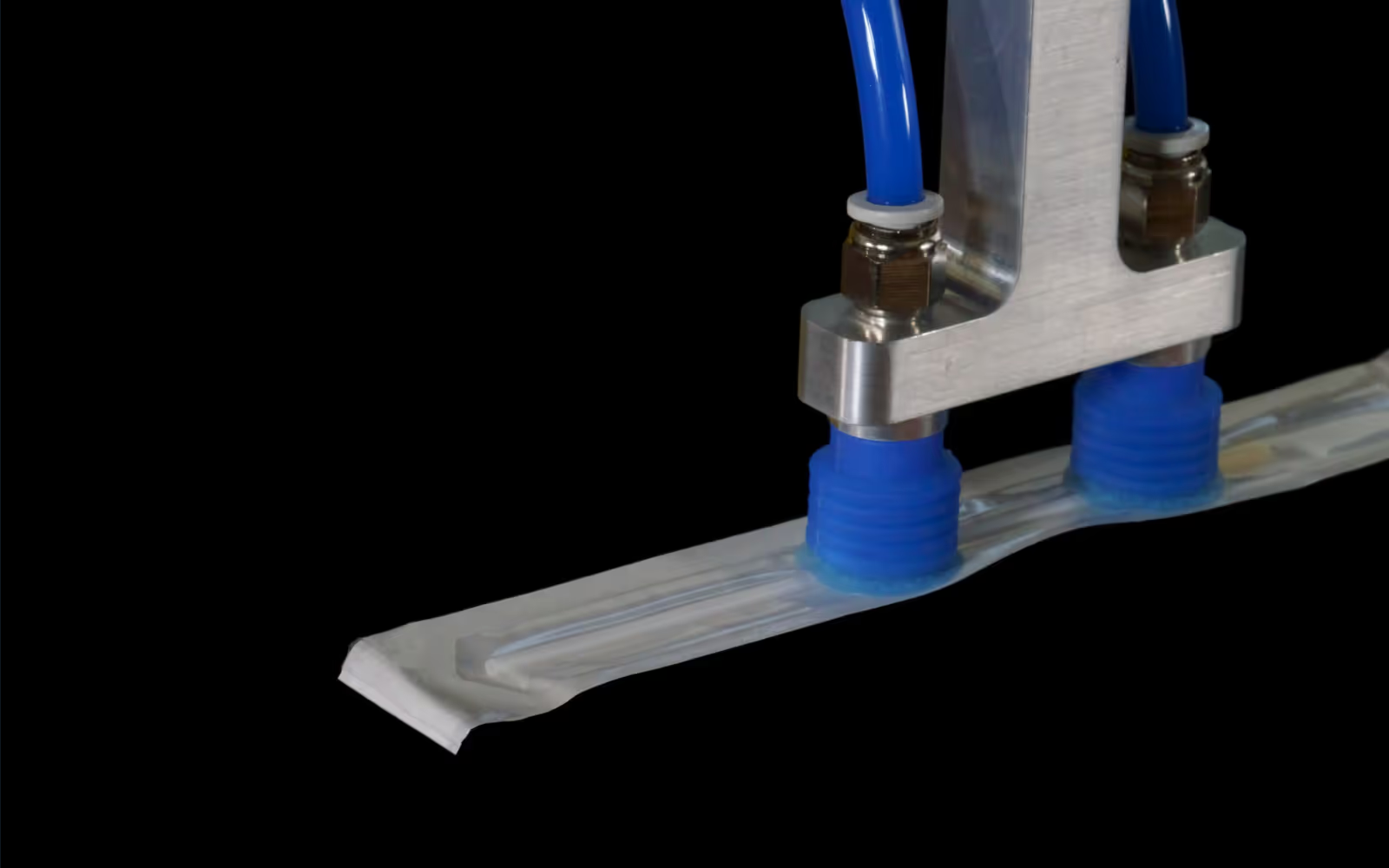
Legacy systems rely on rigid template matching. If an incoming part doesn't match the exact 2D pixel pattern stored in its database, the system flags a false reject. When packaging deforms, flexes, or warps under tension, rigid template matching fails—even if the box's contents are completely undamaged.
Overcoming the limits of traditional vision requires combining high-density 3D point clouds, deep learning, and real-time motion planning. Software platforms like CapSen PiC give standard industrial hardware the spatial intelligence to locate, pick, and manipulate arbitrary objects from cluttered environments.
Instead of simply asking "is an object there?", spatial AI calculates "how is this item oriented in 3D space, and what is the safest, highest-probability grasp angle?" By generating dynamic, collision-free trajectories on the fly, robots can navigate tight bin walls and pick complex, tangled geometries without manual intervention.
Upgrading hardware perception delivers immediate operational benefits across the facility floor:
By replacing diagnostic dead ends with continuous data collection, operations teams move from reactive troubleshooting to proactive process optimization.
Scaling warehouse and factory automation no longer requires re-architecting your entire floor to suit rigid machinery. By equipping standard hardware with advanced spatial AI, facilities can handle unpredictable, unstructured environments with speed and precision. Explore how CapSen Robotics transforms complex bin picking, inspection, and high-mix automation challenges into dependable operational intelligence.